


Australia's adversarial China policy
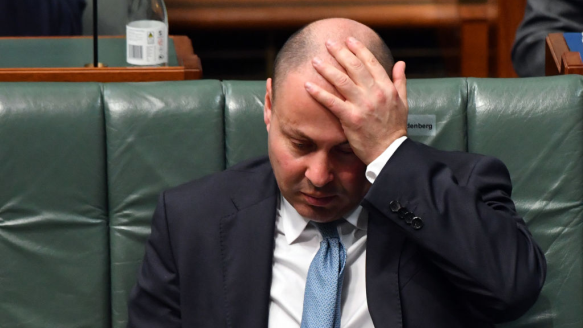
Australia Treasurer Josh Frydenberg reacts during Question Time in the House of Representatives at Parliament House in Canberra, Australia, June 22, 2021. /Getty
Editor's note: Daryl Guppy is an international financial technical analysis expert. He has provided weekly Shanghai Index analysis for Chinese mainland media for more than a decade. Guppy appears regularly on CNBC Asia and is known as "The Chart Man." He is a national board member of the Australia China Business Council. The article reflects the author's opinions and not necessarily the views of CGTN.
On September 6, Australian Treasurer Josh Frydenberg gave a speech to urge his nation of firm stance against China with the background celebrating 70 years of the Australia, New Zealand and the United States (ANZUS) defense treaty between the three countries. Australia has been somewhat desperate to show how good a friend it has been to the United States, even if the United States has not always reciprocated in full.
Frydenberg used the state of the Australian economy as evidence that Australia had successfully withstood the impacts of Chinese trade restrictions. It's certainly true that some Australian industries have been able to find substitute markets for those lost in China. It's equally true that many businesses have not been able to find substitutes.
In his rush to highlight Australia's economic resilience, Frydenberg neglected to mention how the United States – the good friend ANZUS partner – has quickly stepped into the void left by Australian industries in China. U.S. beef exports were an almost perfect replacement for the tonnage lost by Australia due to trade restrictions.
The idea of standing shoulder to shoulder with our best friends doesn't seem to have the same cachet in the United States.
Frydenberg used this leadership address as an opportunity to berate China and highlight how China's combination of economic strength and global integration "poses new and significant challenges for many countries." He said Australia is "on the frontline" of growing strategic competition between China and the U.S. He describes China as "more confident and assertive" and called this "a defining feature of the economic and security landscape we face."
Despite a government wish that this view represents a united Australian front, it is a view that does not enjoy unqualified support from business or from those who are attuned to a more nuanced view of the change that is taking place in the region.
Just days prior to Frydenberg's speech former Prime Minister Paul Keating said "the Morrison government is wantonly leading Australia into a strategic dead end by its needless provocations against China."

A Chinese national flag flies outside the Chinese Embassy in Canberra, Australia, May 10, 2021. /Getty
David Olsson, president of Australia's peak China business body, the Australia China Business Council said, "We encourage China to focus on the complementarities of the relationship and view the relationship as one of opportunity, rather than threat or uncertainty."
Stoked by a mixture of attitudes derived from U.S. bible-belt fanaticism, a well-coordinated campaign of foreign influence through think tanks funded by the U.S. and the UK arms manufacturers and the mistaken idea that China is an expansionist state like the old Soviet Union, the Australian government has become hostage to a particular brand of reworked imperialism.
In June, Australian Prime Minister Scott Morrison encouraged European naval fleets to visit the South China Sea in a dangerous exercise of saber rattling. Morrison expected China to obey the decisions and rules adopted by the G7.
It's a body of thought that is astounded that China has the temerity to challenge the primacy of the United States and to even suggest that China should play an increased role in setting the rules that form the basis of the global order.
It's a body of thought that seeks to deny China's place in the world and to condemn as unacceptable Chinese aspirations for improved living standards.
Keating said, "China's great problem is that it is now a state as large as the United States, and with the potential of being much larger – an unforgivable sin for American triumphalist."
Until recently, Australian business has largely kept quiet about their increasing concerns around the ramped up rhetoric in the hope that it would prove to be a passing phase. Business leaders and others have become increasingly concerned about the impact of this approach not only on Australia's trade with China, but Australia's relationship with the region.
Treasurer Frydenberg suggests Australia can benefit from a China plus strategy. It's a sound approach for any trade-dependent economy but it does not have to rest on the vilification of China. That's a message that he hopes will play well to Australia's U.S. friends but it does little to assist with engagement with China. Just as importantly, this China-bashing does not sit well with Australia's other trade partners in the region. They generally have a far more complex relationship and sophisticated understanding about China and their trade with China.
Frydenberg's attitude and comments are designed to curry favor with the United States. They reflect a wishful economic thinking where the true economic impact of Australia's poor relations with China have been masked by Australia's fairy-tale COVID-19 economic resilience, supported ironically, by Chinese demand for iron ore and coal.
(If you want to contribute and have specific expertise, please contact us at opinions@cgtn.com.)

相关阅读
-
澳洲学者:对美国唯命是从的澳大利亚也难逃“美国优先”大棒砸下
-
澳洲学者:美国说什么“强化供应链”,到头来还是为打压中国

-
澳专家:G7广岛峰会嘴上说的都是“秩序”,心里想的都是“霸权”

-
China stock market opportunity
-
G7 blue dots or BRI red spots?

-
Australia on a 'mission to provoke imperial resurrection'
-
Australia pines for the past

-
Essential concepts to embrace and discard to understand China
免责声明:本网站信息仅供一般参考,不构成投资或财务建议。虽力求准确与完整,但不保证信息的准确性、完整性或时效性。投资有风险,决策前请咨询专业独立顾问。使用本网站即视为接受本免责声明。
热门点击
-
- 【澳股聚焦】ASX年内涨幅归零之后 市场在等待什么?
-
- 【异动股周报】NMD首秀飙升 DAL见矿翻番 ALV单日飙200% 资源与生物科技双线爆发
-
- 【异动股】Image Resources(ASX:IMA) : 一家市值3千万的澳洲矿企 手里捏着龙佰集团最想要的下一座矿
-
- 中国资本vs澳洲关键矿产博弈观察:兴业银锡与两家ASX小盘勘探股的“恩怨情仇”
-
- 【10.13】今日财经时讯及重要市场资讯
-
- 嘉能可登陆澳交所 三巨头鼎立时代开启 ASX铜矿标的稀缺格局迎破局者
-
- 【10.14】今日财经时讯及重要市场资讯
-
- [更新]【10.15】今日财经时讯及重要市场资讯
-
- 【10.12】今日财经时讯及重要市场资讯
-
- 【异动股】从沉寂到爆量:SKK(ASX:SKK)的信任生意 正在盘口里被重新定价
-
- 2026年IMARC矿业大会悉尼之约 澳大利亚矿业技术与创新力量的全球汇聚
-
- 液冷数据中心开发商Firmus澳交所上市在即 揽获OpenAI合同大单
-
- AI热潮的首次集体迟疑:Firmus折戟与AirTrunk搁浅 一周之内两次警示
-
- 澳储行纪要:15年利率新高背后 澳洲通胀的“内因”正在扩大
-
- 新州反对党推动工资税减免立法 起征门槛拟提高至150万澳元 中小企业税率拟降至4.75%